Art Deco Clock Garniture Styling: What Belongs Beside the Clock You Already Have
The clock sits on my living room mantel now, black slate squared off against a plinth of rouge marble that outshines everything near it without trying to. I found it on an ordinary shelf, in a shop that had nothing else worth remembering, which is precisely how the best finds tend to announce themselves. I walked over already braced for a price that would send me back to browsing. Instead the tag read low enough that I assumed someone had made a mistake. A few days earlier I'd brought home an Erté print. The two belonged together before I'd even carried the clock to the counter.
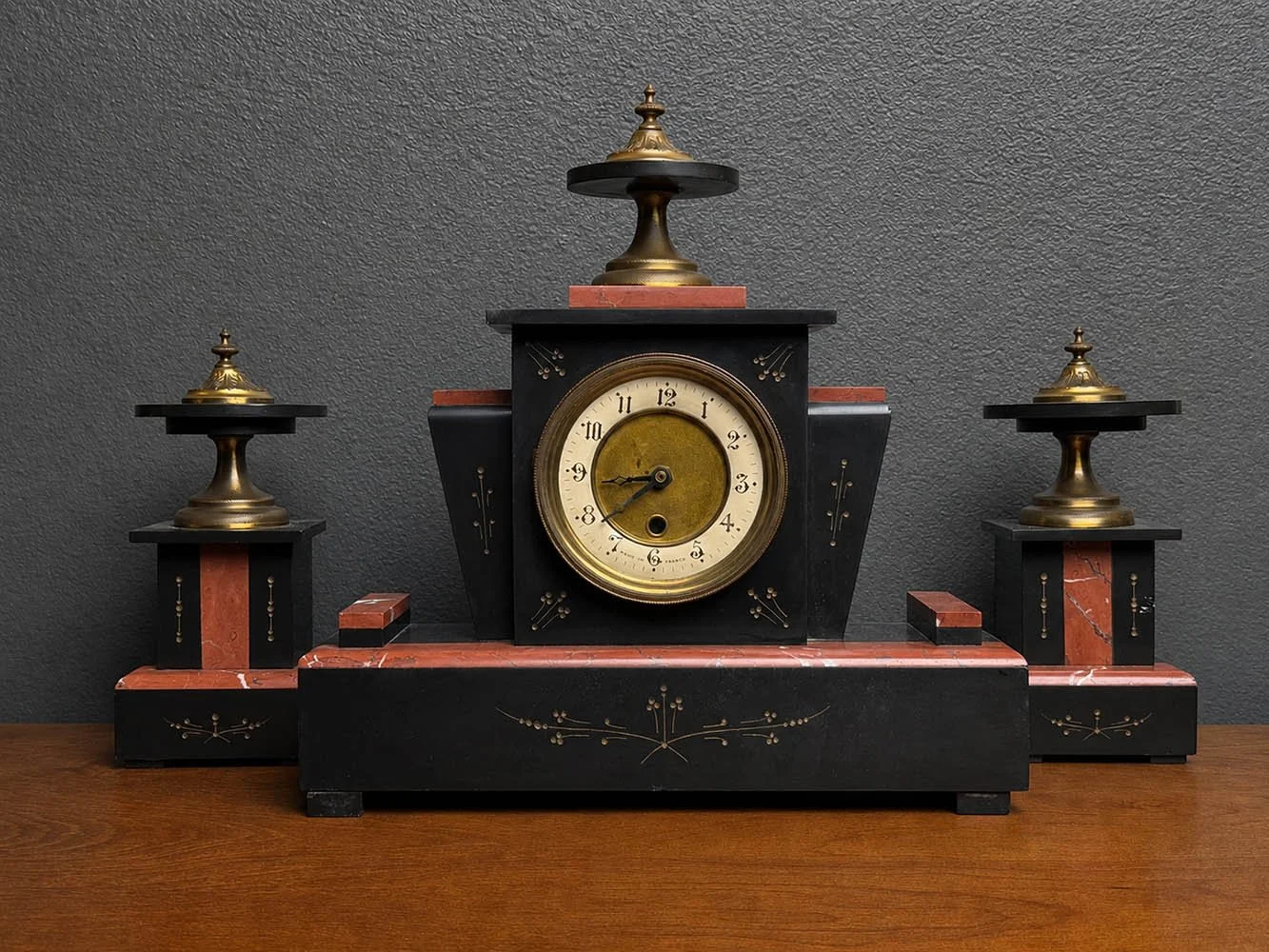
The clock alone would have been enough. Then I noticed the two flanking finials a few feet away on the same shelf, clearly cut by the same hand as the case, and the decision made itself. Up close, the dial read Made in France in small type beneath the numerals, the kind of detail that only surfaces once you're standing close enough to earn it.
Why Art Deco Keeps Pulling Me Back
I shop with my rooms already loose in my mind, and Art Deco is almost always somewhere in that mix. It isn't that the decades after it lacked a voice of their own. The 1960s and 70s produced work that was genuinely inventive alongside the merely functional, and Memphis design in the 80s wasn't asking anyone's permission either. But Art Deco still sits apart for me. It feels less like a style applied to a room and more like something that was simply in the air, glamour as a daily condition rather than an occasion.
That's part of why the garniture worked on sight, detailed enough to reward a second look, restrained enough never to tip into anything gaudy. Art Deco garnitures borrowed from the movement's emphasis on symmetry and architectural composition, and the mantel remains one of the few places in a home where that balance still reads naturally, nearly a century later.
What Venice Had
I know Venice's antique markets well enough to walk in without expecting a room full of Art Deco, though I hoped for a little more than I found. The booths there tended to run toward the back half of the twentieth century: real mid-century pieces, a strong showing of the 1970s, a genuinely good stock of world eclectic art and artifacts. True 1980s postmodern glam was thinner than I expected, and far less common than the mid-century furniture surrounding it.
Black Lacquer pulled at me more than once walking through, pieces that would have been an easy yes for that collection specifically. Nothing read as Art Deco the way my garniture does, and that turned out to be its own kind of useful.

Antique stores rarely sort themselves by decade so much as by vibe: newer repurposed and handmade work, the leftovers of an estate sale, something softer and more cottage-leaning, or genuine nineteenth century material further back. Most fall somewhere in the second half of the twentieth century, with newer pieces mixed in. Learn which vibe a shop leans toward and you'll know exactly when a trip pays off.
A few objects still earned a real look. A bronze figure caught mid-motion, sculptural enough to hold its own without a matching set built around it. A weathered military bust with real presence through the face and shoulders. A pair of French candlesticks, simple in a way that's harder to find than it sounds, since most of what I already own leans more ornate. Nothing came home with me that day. I photographed everything anyway, knowing I'd want to remember it the next time the hunt called for exactly that register.
How to Style a Garniture
Treat a garniture as one composition, not three separate objects arranged near each other. The clock is the focal point. The side pieces exist to frame it, not to compete with it.
Before adding anything else to a mantel like this, step back across the room. If your eye jumps from object to object instead of settling on the clock first and moving outward, the arrangement is already doing too much. The strongest Art Deco mantels feel restrained, and not because they hold fewer objects. It's because everything on them is having the same conversation, through shared material, compatible geometry, a scale that stays balanced from one end to the other.
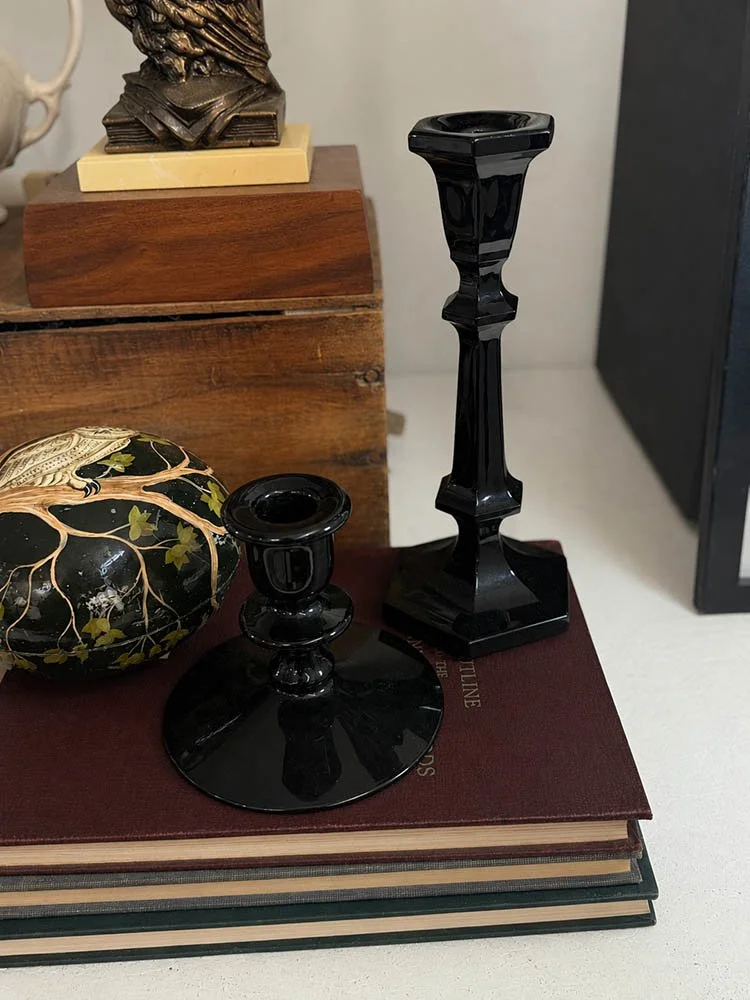
Art Deco is already dramatic on its own terms. Crowd too much of that drama into too small a space and a mantel stops reading like a room and starts reading like a display case. The goal is atmosphere, not a showroom, and atmosphere gets harder to hold the moment two or three pieces start competing for the same glance.
Leave room around the arrangement to breathe. Resist the pull to fill every inch of the mantel. Empty space is what lets marble, brass, or dark wood register instead of dissolving into whatever sits beside it. A mantel almost always reads as more luxurious with less on it, not more. On the hearth below, I keep a brass peacock fireplace screen. Its fan shape works with the lines of the clock, so from across the room the two read as one arrangement.
The piece worth building around is the one that stopped me on that ordinary shelf: real weight to its form, flanking pieces clearly made to sit beside it rather than added on later, one detail that only reveals itself once you're standing close enough to notice.
Explore The Mantle for more Art Deco vignette styling, or read A Room That No Longer Exists for another piece on what antiquing hands back to you.
Know where to hunt before the weekend.
A small edit of the estate sales, auctions, and shows worth knowing about. Free every Thursday.
