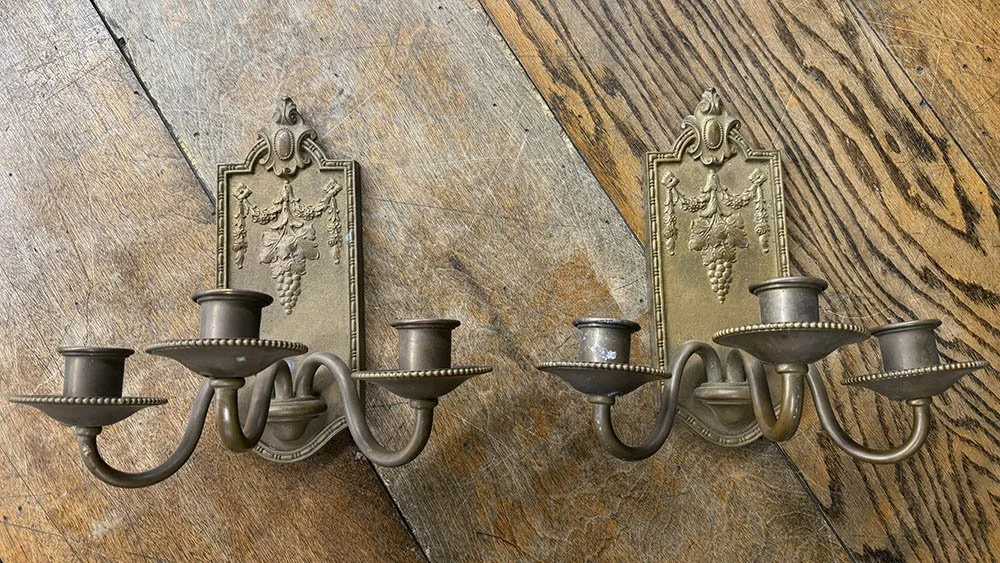
I had been looking for antique sconces for a few days, and they're harder to find than you'd think. Part of it, I suspect, is that taking a wired sconce out of a wall leaves an open electrical box behind, so many stay with the house. The lighting stores I tried were full of newer pieces, and I wanted something with a little character. So last Saturday I drove to Antique Adventures in Ventura.
I found the shop years ago by accident. I was driving the 101 home from a trip, needed to get off the freeway, and saw the large letters announcing my favorite pastime: ANTIQUE ADVENTURES. I've gone back ever since, so I knew where to look next.
That day I found three pairs, two of them tagged as brass candle sconces. I couldn't tell how old any of them were, so I'll stick to what I could see.
The three-arm brass sconces
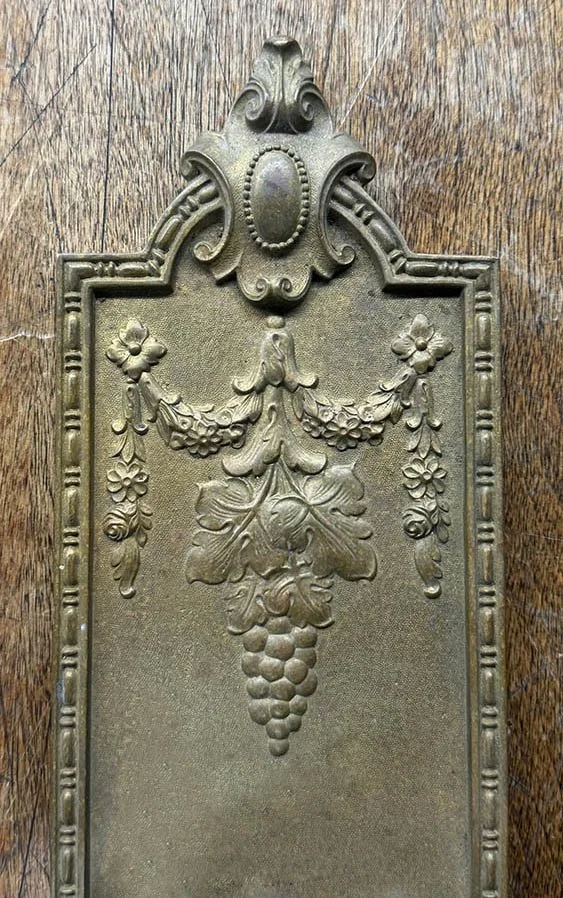
These were the first I noticed, mostly for the crest and the detail across the backplate. At first I thought they were electric, since the cups look like sockets and there's a hole in the back. Looking closer, the cups had no threading and there was a screw at the bottom. As they are now, they're candle sconces, though I couldn't tell whether they'd always been that way. The swags and beaded borders are details associated with the Neoclassical designs of Robert Adam. They felt solid in my hand, which I always notice in a piece of brass.
The tag said vintage brass. If you want to check a piece like this yourself, look at the back and at any worn spots. Bare brass is generally yellow, while silver-gray metal can point to a different material under the finish. If a magnet sticks to the backplate or arm, that part is likely iron or steel. Brass and zinc are both nonmagnetic, so a magnet that doesn't stick won't settle it on its own.
I would have hung them in my living room, but I didn't have a spot for them yet.
The painted sconces with pull chains
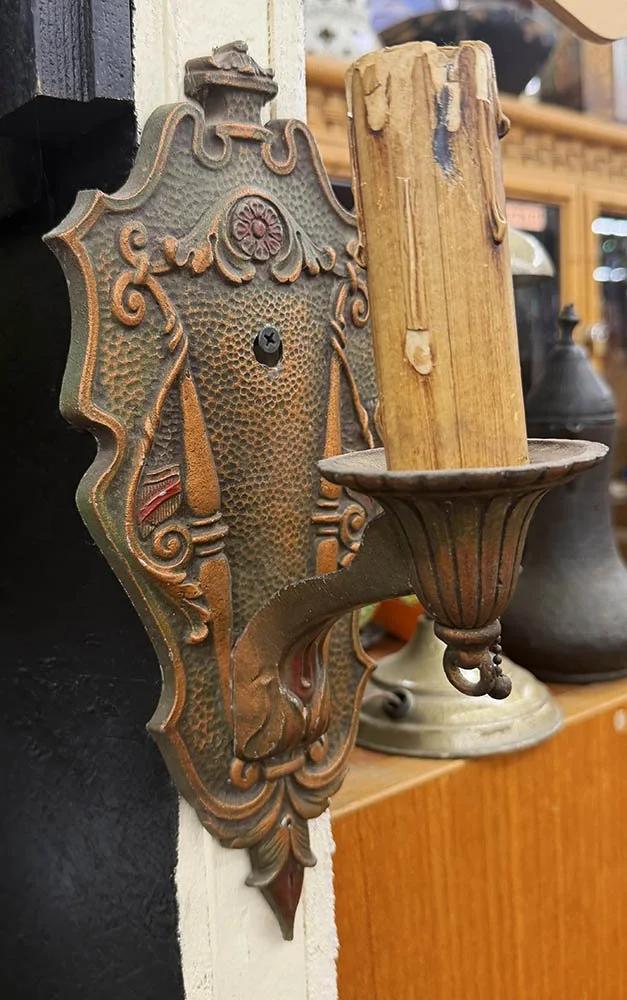
I've seen this look in old buildings all over Los Angeles: metal with a hammered texture, painted in copper, green and red. It's characteristic of Romance Revival lighting, popular in the 1920s and 1930s, and the multicolored finish is called polychrome.
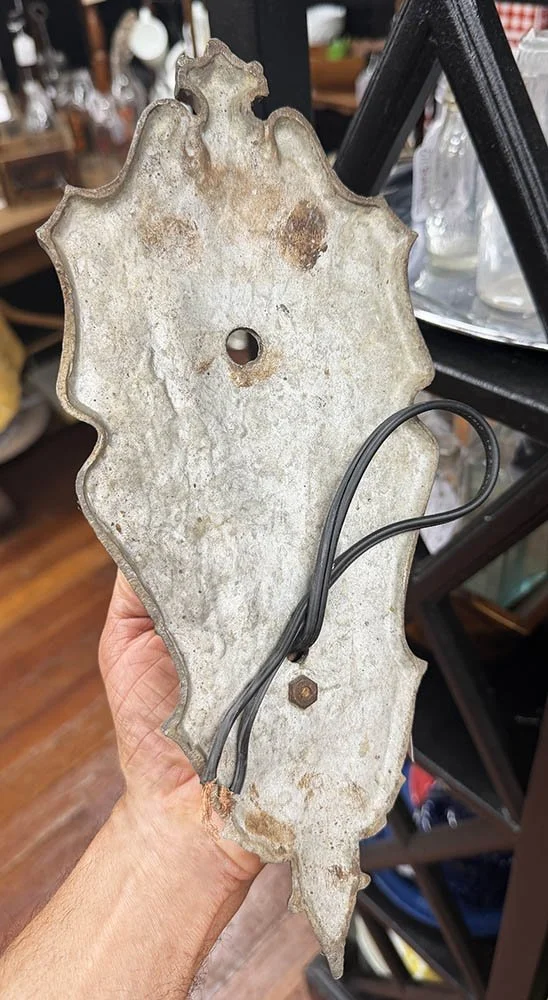
I turned one over looking for a maker's mark and couldn't find one, just bare gray metal and some old wire ends. I'd be careful with the painted finish and wouldn't strip or polish a piece like this without knowing more about it. I'd also have the wiring and sockets checked by a qualified electrician before installing them.
The candle sconces with cast faces
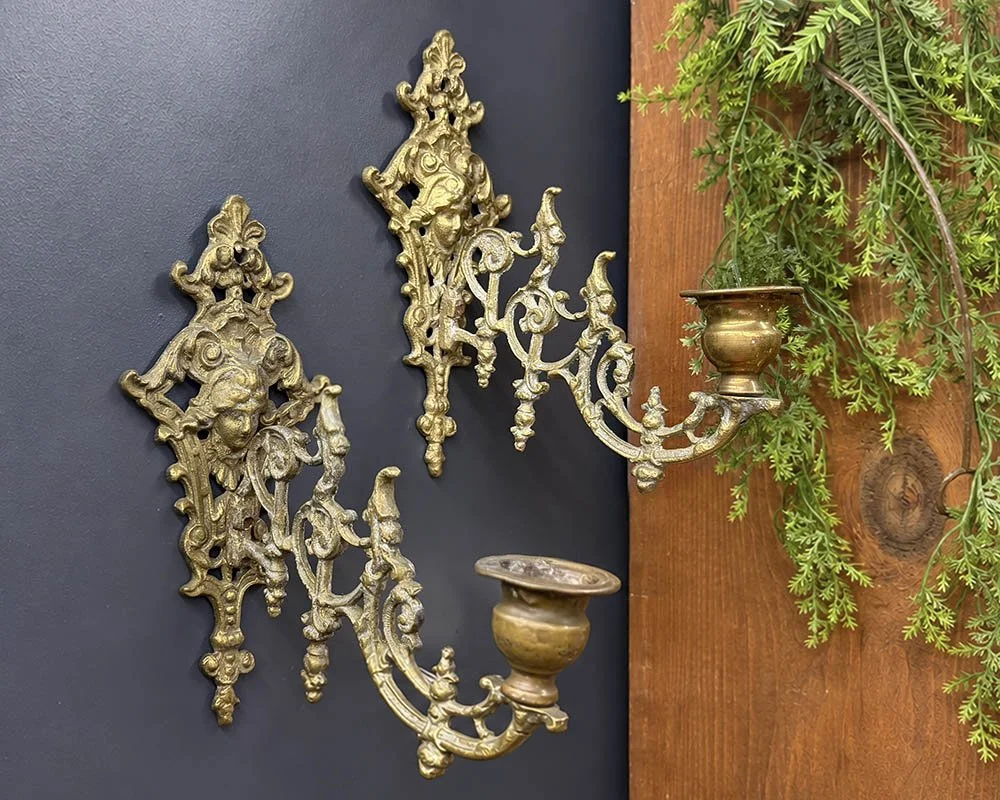
These hung in one of the last booths I visited. At the center of each backplate is a cast face, a decorative detail called a mascaron. The arms are all loops and curls, almost like cursive handwriting. Delicate scrollwork like this can feel fragile, but these felt sturdy.
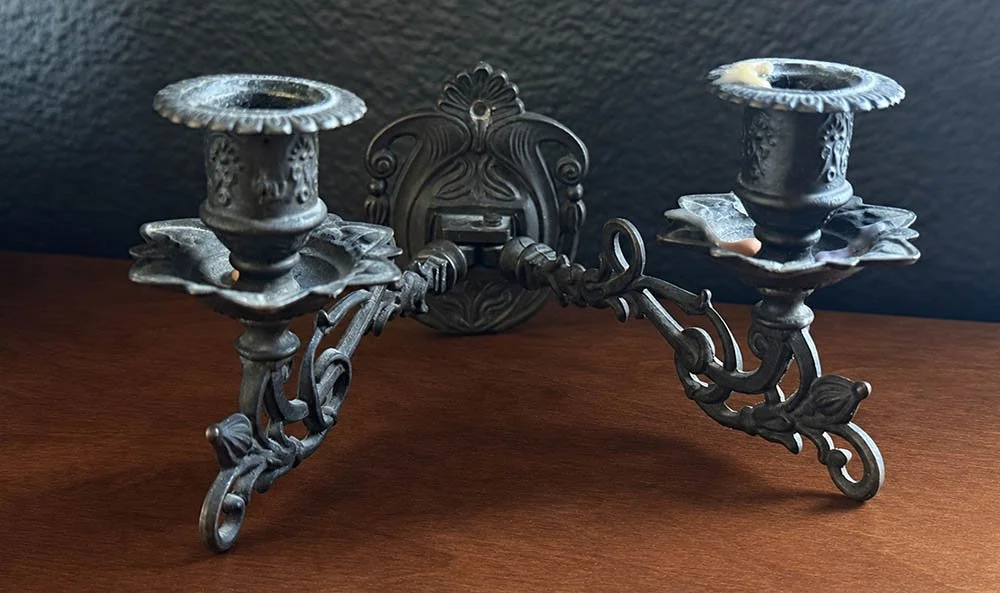
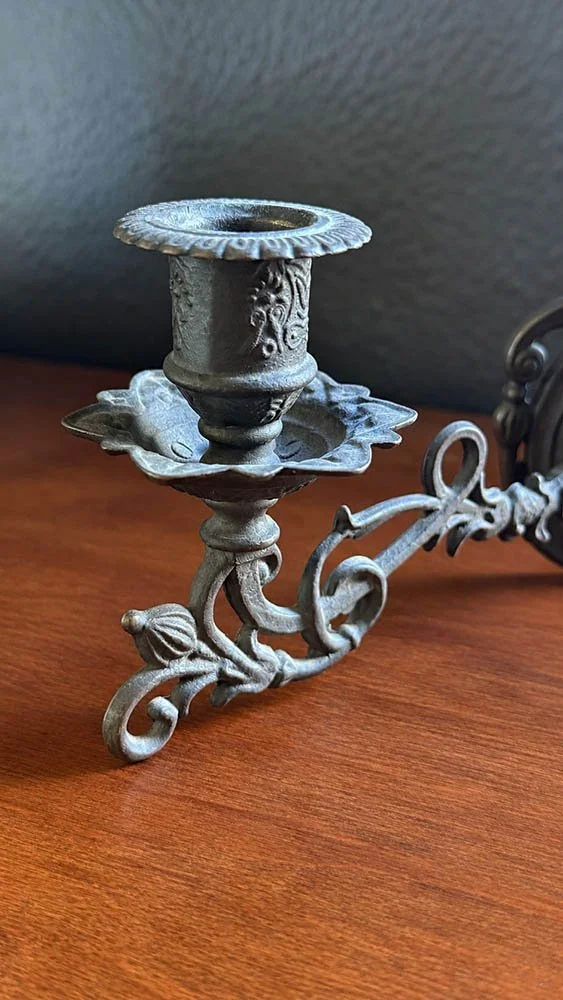
They reminded me of a sconce I found in Montauk last year. That one swings on a hinge at the backplate. Similar brackets were made for upright pianos to light the sheet music. I hung mine under a painting until I found a lamp I loved for the console below. Now it's in my antique reserves, and I rotate pieces in and out so I can enjoy each one at different times.
What I've learned looking for sconces at antique shops
I buy both of a pair when available, even when I think I'll only use one. I may want the second later, and a matched pair is much harder to find than a single.
I make sure everything is there. On a pair, both should match, with no candle cup, drip pan or candle cover missing. If I'm not sure, I do a quick Google image search for similar pieces to see whether anything is missing or changed, and sometimes I learn something interesting about it along the way.
I pay attention to the weight, the joints and how securely everything is attached, and I look at the back for clues about the metal.
When I'm buying for a specific spot, I measure. For a hardwired sconce, I check that the backplate is large enough to cover the electrical box, and in a narrow hallway I check the projection, which is how far the sconce extends from the wall.
I've had hardwired sconces converted to plug-in at a lamp shop. If you're considering one, ask whether it's suitable for conversion before you buy it.
If I love something but I'm not sure, I go back the next week or the next time I'm passing by. If it's still there, it was meant to be.
If you're ever on the 101 near Ventura, take the exit for Antique Adventures (@antique.adventuresllc). There are more antique wall sconces I've photographed on the site, and if you'd like the look with new wiring, there's antique-inspired wall lighting made today, plus a guide to how high to hang wall sconces.
A note on safety
Before using a vintage electric sconce, have it professionally checked. A lamp shop or a licensed electrician can tell you whether the wiring needs replacing, and old insulation often does. This matters even more with a hardwired sconce, since once it's on the wall it's hard to take down and look at. Adding a new fixture where there wasn't one usually needs a permit, so check with your city first. Make sure any sconce is securely mounted. If you light real candles in one, keep the flames at least 12 inches from anything that can burn and never leave them burning in an empty room. If you can't keep that clearance, use flameless candles.
