How to Style Bookends
My partner found it first.
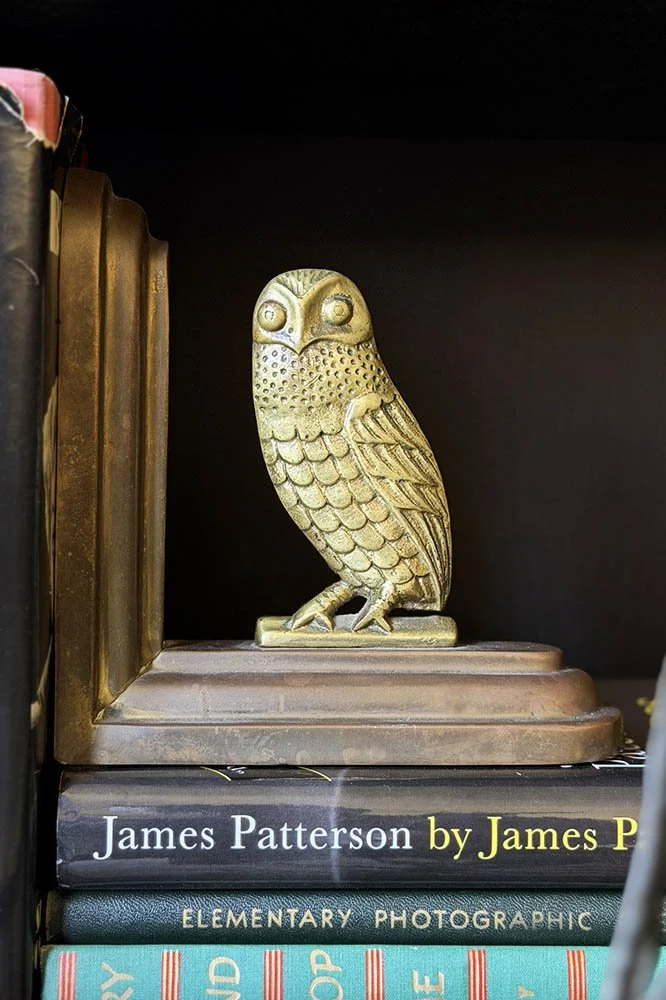
They were digging through my decor archive for something for their own office, and pulled out a small brass owl with a dotted brass breast and eyes like two coins. I took a break from decorating the living room and wandered into the office, and there it was, sitting on a shelf, the placement looking completely natural. That's a good piece, I thought, where did that come from.
It was mine. I'd bought it in college in New York because I liked the weight of it in my hand, put it in a box not long after, and forgot about it completely. My partner had to tell me it was mine. We laughed about it right there. I carried it over that same afternoon, to a shelf with exactly one open end and nothing else there yet. It was the first time I'd actually thought about how to style bookends instead of just where to put one.
Start with what you actually like
If I keep reaching for a piece every time I rearrange a shelf, that's usually reason enough for me to keep working with it, whether or not it matches everything else on paper.
What makes a bookend worth trusting
Where the practical considerations start is further down the line, in whether the thing will do its job. Pick it up before anything else. A bookend that flexes or feels thin in your hand isn't substantial enough for a stack of oversized books, no matter how good it looks empty-handed. My owl is solid through and through, no seams where the casting was rushed, no thin spots that make me nervous handling it. That's not a small thing. It's the difference between an object that holds the books upright and one that gets quietly pushed aside the first time someone adds a heavier book. Brass owl bookends with this kind of detail turn up on Etsy often enough to be worth watching for.
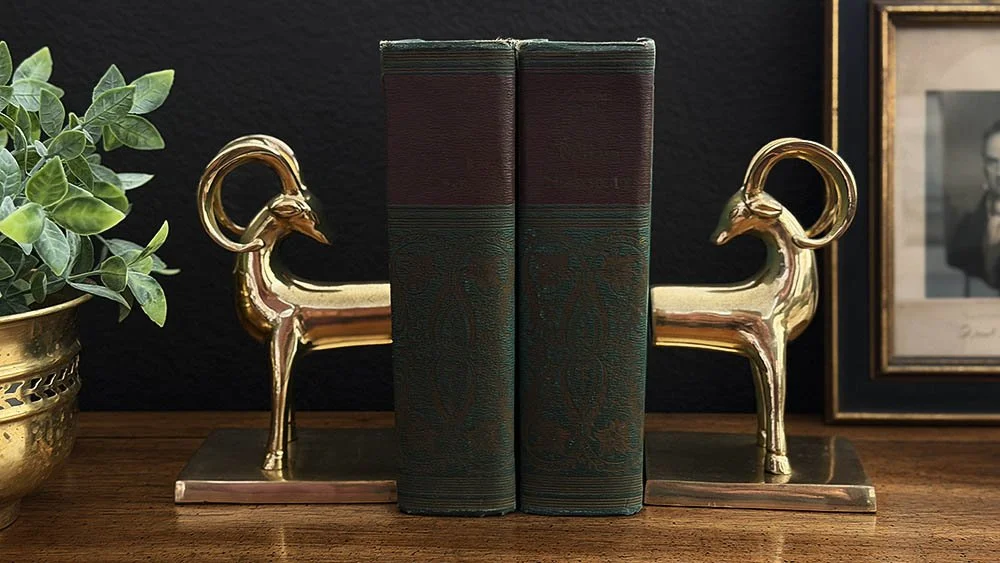
The heavier the books, the more substantial the bookend needs to be, and that isn't only about height. Weight helps, but so does a broad, stable base. Brass, bronze, and stone can look substantial even in a small footprint. Delicate glass and wire usually have less visual weight, whatever their charm. A pair like this brass ibex set has exactly that kind of weight, visible even in the listing photos.
When one is enough
A pair of bookends doesn't have to stay a pair. The real question isn't whether an object technically belongs to a set. It's whether you look at it alone and wonder where the other one went.
Some pairs are designed as two halves of a single composition, with neither side visually complete on its own. Separate one of those pairs, and the missing half becomes obvious.
Nothing about my owl makes me wonder where the other one is. That's why it works fine on a shelf with exactly one open end and nothing else there. The same is true of another set I own. It was sold as a pair, but each bookend is visually complete on its own. Only one is currently sitting on the shelf, and nothing about it suggests something is missing. If you're hunting for something similar, single brass animal figures like this ram bookend turn up on Etsy fairly regularly.
So the test isn't whether there's a gap in the row of books. It's whether the bookend looks complete on its own.
Reading the room before reaching for the object
If I already have the object in hand, I start with the room, not the shelf. What decade am I referencing? How serious or playful do I want the space to feel? What's already happening with color? The physical details, how much shelf, how many books, how much air I want, come after.
If I'm building a shelf out from nothing, that order can flip. The run of shelf and the books that need holding come first, and I choose the bookend according to the space that's left.
Every so often I break my own order anyway, for something I love enough to want a home for immediately, no waiting for the right spot to come along. When that happens, I figure out the trade afterward, what it displaces and where the displaced piece goes instead. It's not the tidiest way to make decisions. It's the honest one.
Letting color do the talking
The books flanking the ibex are a patterned green and rust, chosen for how the color plays against brass, not for anything thematic. The owl's shelf is a different, darker stack entirely, mostly black and deep green spines. Same logic either way. A dark or richly colored cover lets brass hold its own instead of getting lost. That's really the color decision: do you want to notice the books first, or the object first? Brass against something dark creates more contrast. Brass against something warm and close in tone blends in instead of standing apart.
Material can repeat itself elsewhere in the room too, a brass lamp base, an old magnifying glass, a picture frame. Repeating a material in a few different places can connect a shelf to the rest of the room without needing a matched set. See Dark Academia Home Office: Material Before Motif for more on sourcing by material.
Give the silhouette room to work
A bookend is mostly seen from the side, in profile against the spines next to it, so its outline matters more than people expect. My ibex has a strong profile because of the curl of the horns, and leaving open space around it makes that shape easier to see. Crowd it with too many small objects and the outline becomes harder to distinguish. The same logic applies to anything else sharing the shelf. A small object like an antique globe works the same way, best given its own patch of shelf rather than crowded in next to the books.It's the same reason I sometimes leave part of a shelf empty. Negative space isn't the absence of styling. It's what lets the object still look like an object instead of a shape lost in a pile.
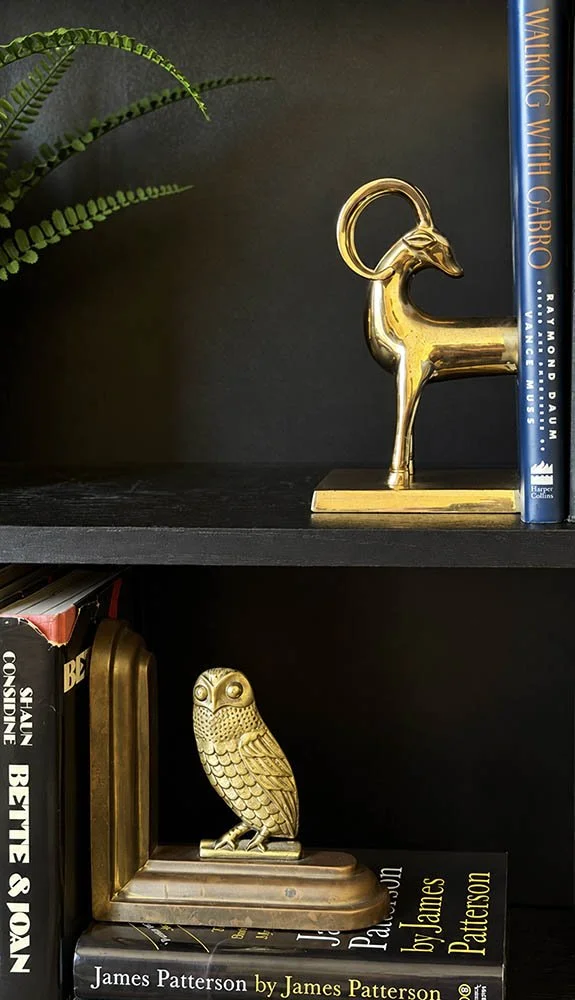
Once you know how to style bookends around weight, proportion, color, and the space you actually have, the decisions get easier. Start with the room, decide whether the bookend works better alone or as part of a pair, and leave enough space to see what made you pick it up in the first place.
Explore more of The Dark Study collection, or browse the full Dark Study Journal hub for more on building a room around a working, thinking life.
