Dark Academia Home Office: Material Before Motif
The sconces were finally right. Three arms each, brass gone soft with age, turned low enough that the shadows barely read against the black walls. My partner and I sat down together for the first time since we'd finished the lighting, in the two wingback chairs we'd spent weeks choosing, and talked. Not about anything in particular. Where we might find a 1950s television cabinet. What still needed sourcing. The kind of conversation that happens easily once the feeling of a room finally clicks.
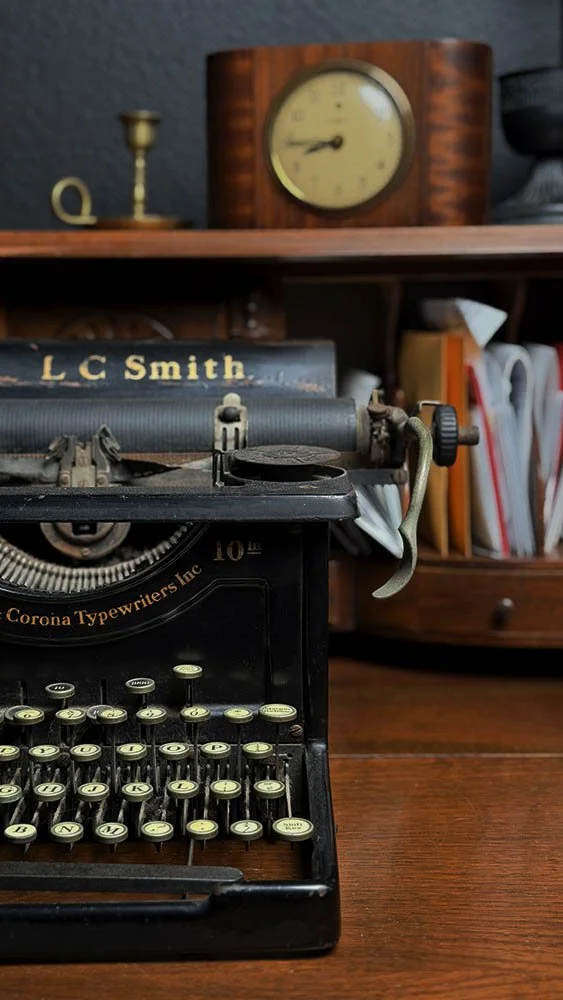
The typewriter is what pulls the eye first. As I started building out this dark academia home office, it was the one object I never had to go find. An L.C. Smith, black enamel worn silver at the edges of the keys, that's been with me for two decades now. I don't know exactly where I first found it, only that I've always been drawn to old things people used to make things, and to the letters and drafts that might have come out of a machine like this one, who wrote them, what they were for. It sits centered on the secretary desk, partly because that's where it photographs best, and partly because that's simply where it belongs.
Material before motif
A dark academia room isn't built from objects that announce the aesthetic. It's built from what those objects are made of. Standing in front of anything in a shop, I'm not asking whether it looks like dark academia. I'm asking about the material, the finish, the wear, the silhouette. Aged brass. Dark wood with visible grain and signs of wear. Textiles with weight to them. Surfaces that show they've been touched. New pieces can echo the same register, but genuine age leaves its own surface behind, one you learn to spot once you know to look for it.
Softness against the hard edges
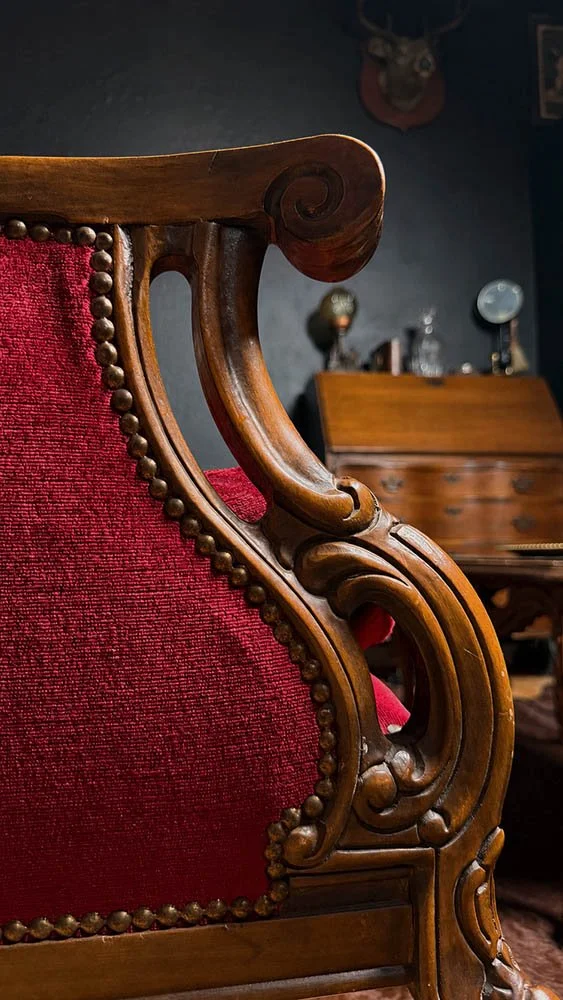
Once the wood, metal, and wall color have done their work, the temptation is to keep adding more of the same, more dark, more hard, more heavy. That's where a room like this can turn severe. The wingback chairs are upholstered in a deep red velvet, and we layered black faux fur throws and pillows over them rather than adding another hard surface. The softness keeps all that wood and metal from tipping into a display case instead of a room you'd actually sit in.
The anchor object earns its space
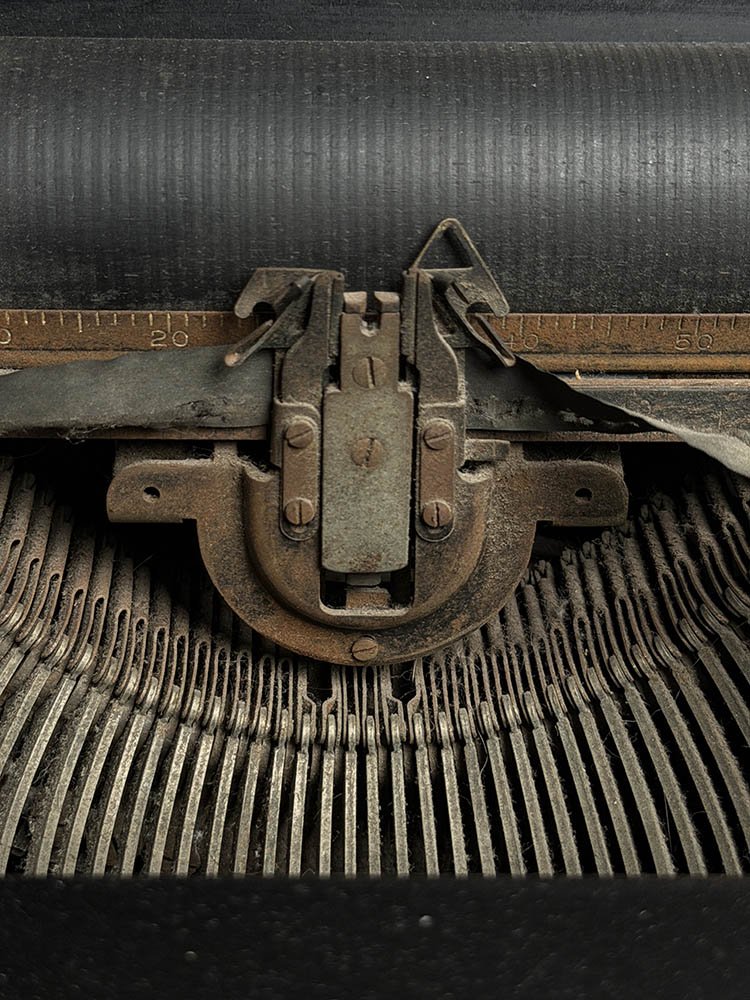
The typewriter works as an anchor because it's real, it's heavy, and it has an obvious history, not because it's labeled "vintage" or arranged to look academic. It's also enough on its own. If you're not sure whether a surface has too much on it, take away the small decorative pieces and look at just the major ones. If the room stops reading as dark academia without them, the smaller objects may be carrying more of the look than you realized.
Before the typewriter went anywhere near the desk, I checked the hinges, the drop-front, and the supports underneath it. A heavy old machine isn't where you want to discover that something has loosened.
Sourcing the desk
The secretary came home with something I wasn't expecting: a small stack of the previous owner's receipts, mostly from the 1980s, tucked into one of the drawers. The seller told us to just throw them out. We kept a few instead.
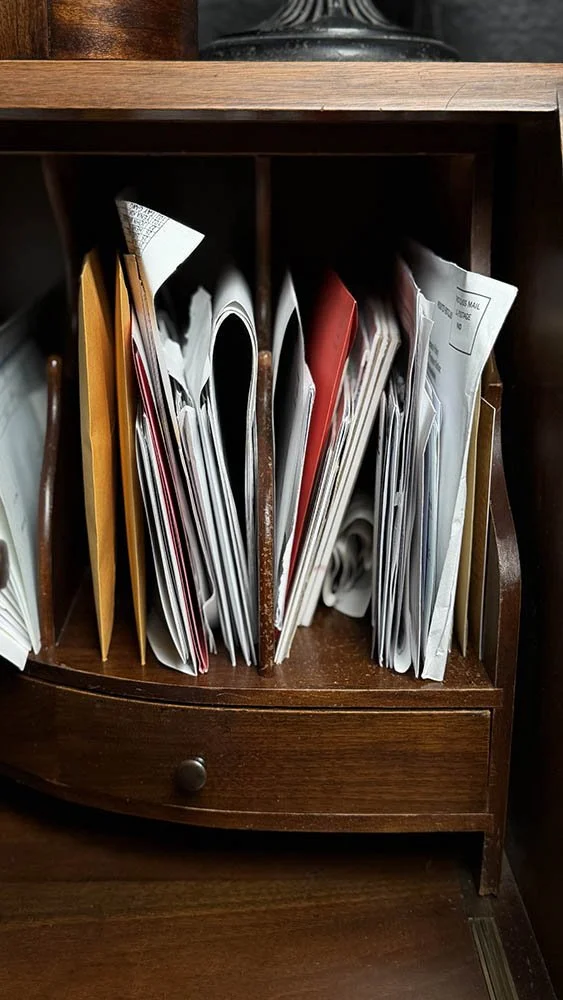
When you're looking at a secretary desk for a room like this, walk away from anything with damage you can't repair or conceal, any strong smell, missing pieces, or obvious staining. Check that the compartments actually suit how you plan to use it, and that the wood tone sits well against everything else already in the room, not too bright, not too dark for its company. The desk is going to be the piece people look at longest. It shouldn't be the weakest one in the room. What sold me on this one, beyond the drawers and the proportions, was the pair of arms that pull out to support the fold-down top once it's open, so the weight doesn't rest entirely on the hinges.
Layering light
The room runs on five sources: two sconces, two lamps, and a small desk lamp, each doing a different job.
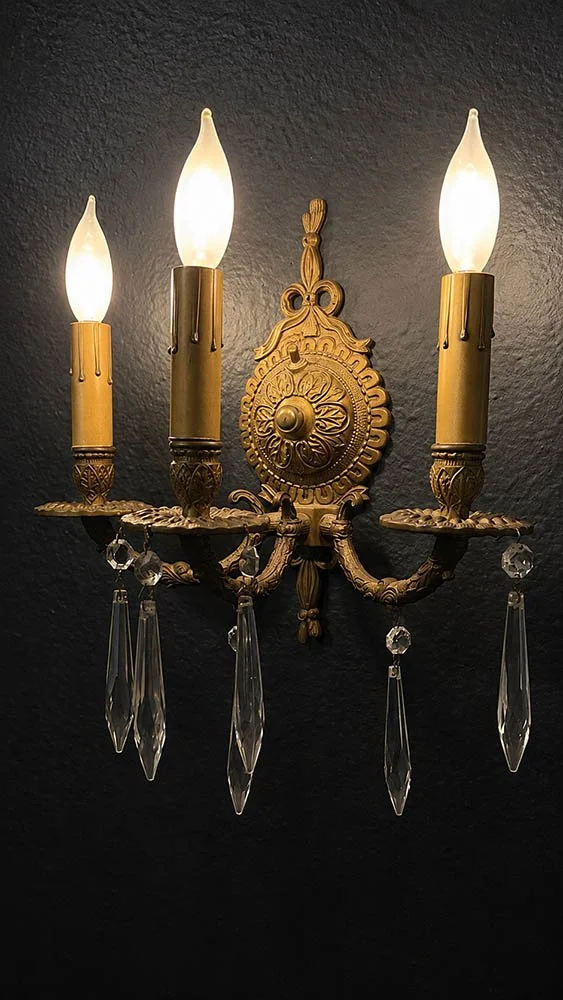
Nothing in the room is meant to be uniformly lit. I look at where I'll actually be sitting, what needs enough light to be seen clearly, and what can fall into shadow without losing the room's shape. Multiple lower sources create separate pools of light instead of one uniform wash. Under warmer light, the brown and amber tones in the wood and brass become more apparent. I'll use a flicker bulb occasionally, more for the effect of candlelight than as an actual lighting plan, but most of the work happens in how the five fixed sources are placed and dimmed against each other.
Mixing eras without it feeling like a set
Almost nothing in this room shares a decade with anything else. The typewriter, the secretary, the lamps, the chairs, they all come from different periods, and the room still reads as one place rather than a costume built from parts.
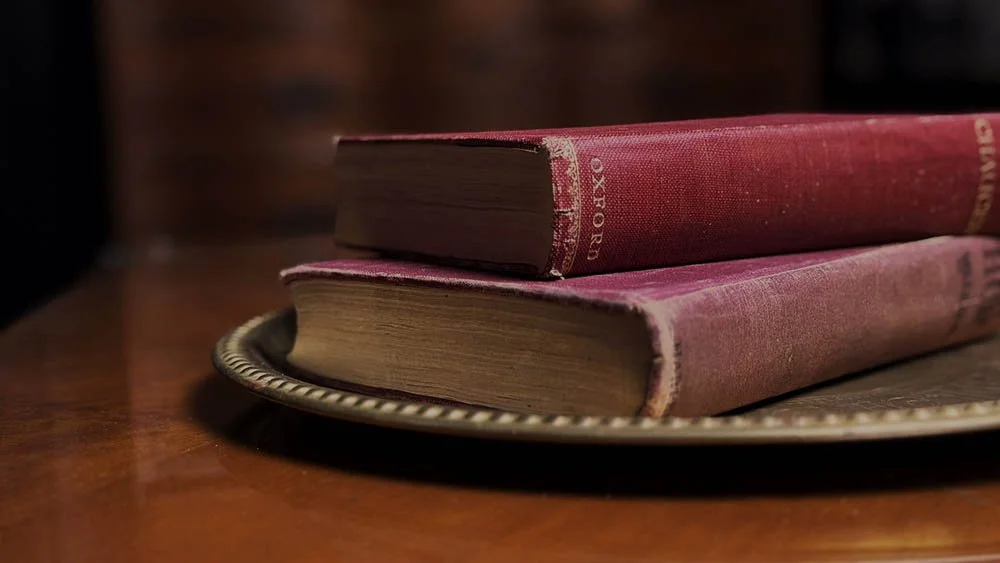
I don't try to match eras. I look at the room as a whole and pay attention to whether the material and silhouette of a new piece sit comfortably with what's already there. In this room, an obviously modern silhouette or a colder, brighter metal becomes louder than I want it to be, so it gets left out.
What stays out
We tried a chaise lounge in this room before the wingback chairs. Two people could technically sit on it, but it made real conversation awkward, too small and too angled for actually talking. It came out fast. The bigger question is what never made it in at all: anything that reads as costume-horror rather than genuinely old. An object from the actual period that happened to be playful or a novelty in its own time is different. A century-old toy carved from real wood can have enough material and craftsmanship behind it to sit differently in the room than a smooth plastic reproduction of the same idea.
Working in the room
The desk still has to function. The drop-front top closes over whatever's underneath, papers, cables, the ordinary clutter of actual work, so the room doesn't stop being itself the moment the workday ends. Cables get wrapped or routed through whatever will hide them, tucked into the desk's own storage where possible. A laptop cord that can't disappear entirely just gets put away once the work is done.
What the desk carries forward
A reproduction can put you in the mood of a period, but it was never actually there. The receipts were, someone's real Tuesday afternoon in the 1980s, folded up and forgotten in a drawer. It's yours for now.
Explore The Dark Study for more, or read What I Learned Hunting Frames for a Gallery Wall and The Antique Globe That Was More Than a Prop for two more pieces built the same way: real objects, real history.
Know where to hunt before the weekend.
A small edit of the estate sales, auctions, and shows worth knowing about. Free every Thursday.
